
Certifications and Machine Parameters That Define a Reliable SMT Turnkey Solution
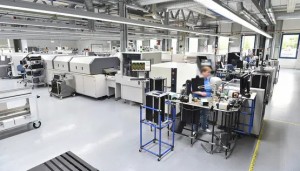
An SMT turnkey solution is a complete PCBA assembly line delivered by one supplier instead of a collection of separately sourced machines. In a typical configuration, the line starts with a PCB loader, moves through solder paste printing, inline SPI (solder paste inspection), pick and place, reflow soldering, AOI (automatic optical inspection), and ends at an unloader. Optional blocks can include X-ray BGA inspection, ICT, buffer conveyors, PCB depaneling routers, and PCBA cleaning machines.
For a high-mix electronics manufacturing line, the real issue is not simply whether the equipment list looks complete. A turnkey solution works only when the machine parameters match your boards and components, when compliance documents match your destination market, and when the supplier can support the line after installation. This guide explains the parameters, certifications, and service evidence to verify before committing to an SMT turnkey solution. Motek (Morel Equipments Co., Ltd.) is used as a documented example because its equipment specifications, certificates, and service terms are available in the supplier profile.
Problem Definition: Why Parameters and Certifications Are the High-Risk Areas
High-mix EMS factories often run 24/7, handle multiple board formats, and face tightening quality expectations from automotive, medical, and communication customers. Under these conditions, small mismatches create large problems. A pick and place machine rated for one component range may not handle 03015 packages. A reflow oven with too few heating zones may not hold a stable profile for dense boards. Without the right certifications, machines may be delayed at customs or rejected by end customers.
These risks are not solved by choosing a familiar supplier name alone. They are solved by checking documented parameters, certificate numbers, and service commitments.
Industry Background: SMT Equipment Demand and the Shift to High-Mix Lines
The global SMT equipment market was valued at approximately USD 6.6 billion in 2025 and is projected to reach USD 14.6 billion by 2036, according to Transparency Market Research. Asia-Pacific held a 54% revenue share in 2025, followed by North America and Europe.
Placement equipment, which includes pick and place machines, accounts for an estimated 38% to 48% of total SMT equipment market value, according to Persistence Market Research and Cognitive Market Research. The high-mix/low-volume assembly segment is projected to grow at a CAGR of 8.31% through 2031, driven by customized industrial and medical electronics, according to Mordor Intelligence.
Inspection is also expanding. 3D AOI and SPI are identified as the fastest-growing equipment sub-sectors, with a 15.2% CAGR, largely because of automotive zero-defect requirements, according to Persistence Market Research.
Key global SMT vendors identified by MarketsandMarkets include ASMPT Limited, Fuji Corporation, Yamaha Motor, Panasonic, Juki Corporation, and Hanwha Precision Machinery. Fuji's NXT platform and Yamaha's YSM series, including the YSM20R, are described in industry sources as standard modular mounters for high-speed and high-precision placement. A turnkey integrator is not expected to replace these brands; it should be able to integrate them, or equivalent machines, into a line with consistent controls.
Detailed Solution: The Verification Points in a Motek SMT Turnkey Line
Motek is headquartered in Shenzhen, Guangdong, and has supplied SMT equipment and related production solutions since 2011. Motek is represented by Morel Equipments Co., Ltd. The main product list includes reflow soldering machines, plug-in machines, pick-and-place machines, cleaning machines, PCBA protection, and PCB cutting machines. Export markets include the EU, USA, Australia, Canada, and ASEAN.
Pick and place machine
The placement machine in Motek's equipment list is the Hanwha Decan S2, a high-speed pick and place machine with two gantries and ten spindles per head. Its optimum speed is 92,000 CPH with the HS10 head. Placement accuracy is ±28 μm at Cpk≥1.0 for 03015 chips and ±25 μm at Cpk≥1.0 for ICs. The machine handles components from 03015 to 12 mm with a maximum height of 10 mm and standard PCBs from 50 x 40 mm to 510 x 460 mm. The frame uses high-strength aluminum alloy.
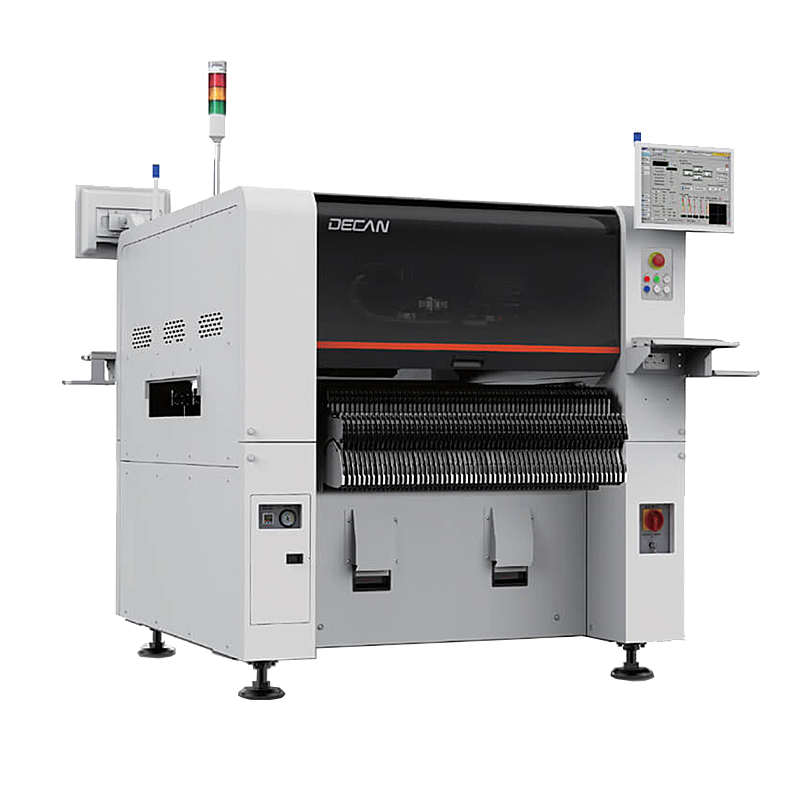
For a high-mix line, confirm that these parameters cover your smallest component, largest board, and target cycle time. Feeder planning should be part of the turnkey scope, especially if you use 8 mm, 12 mm, or 24 mm tape widths.
SMT reflow oven
The documented reflow oven is the XMR-800D. It measures 5520 x 1430 x 1530 mm and weighs approximately 2710 kg. It has eight top and eight bottom heating zones, a heating zone length of 3110 mm, and three top and three bottom cooling zones. The rectifying plate structure uses small circulation, and the exhaust volume requirement is 11 m³/min per exhaust, with two exhausts.
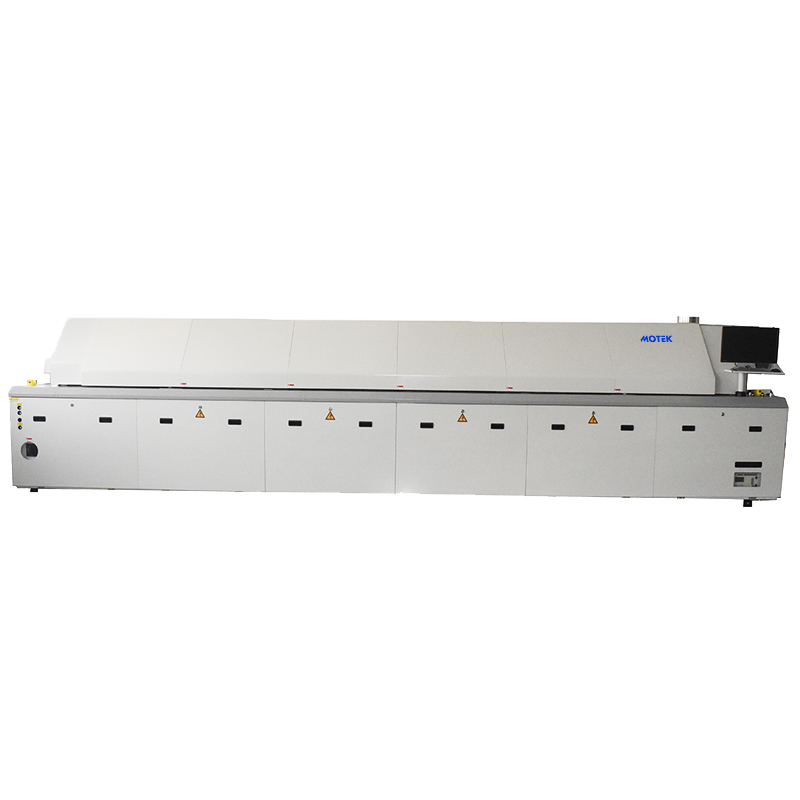
More heating and cooling zones give the process engineer more freedom to control ramp rate, soak time, and peak temperature. This matters on high-density boards and boards with mixed component masses.
Automatic online glue dispenser
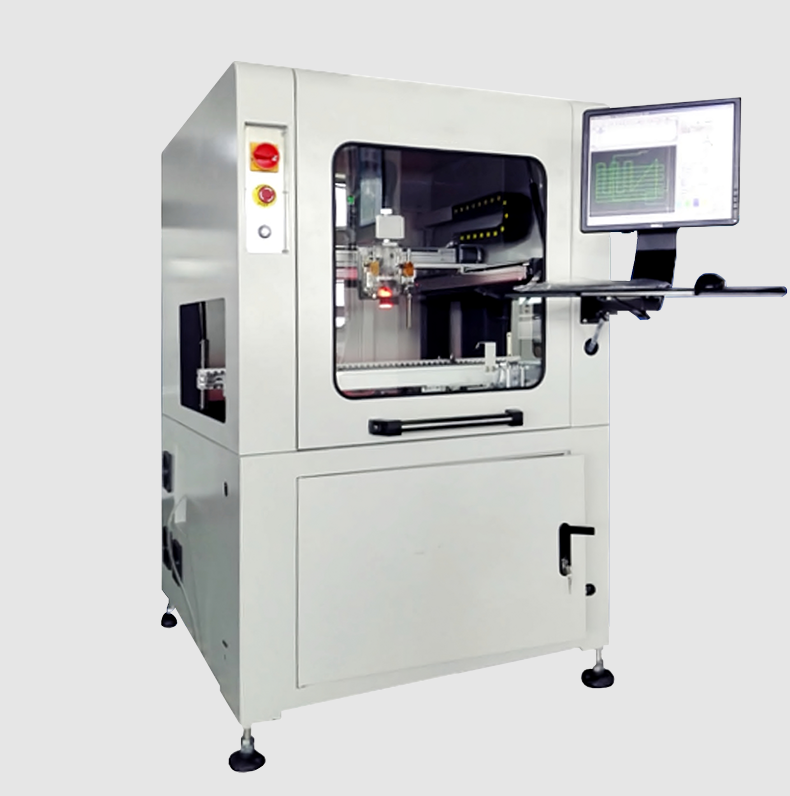
For mixed-technology boards that require adhesive before soldering, the equipment list includes the automatic online glue dispenser HMH830D. Its platform is a 20 mm steel plate with chrome plating. The machine weighs 650 kg and uses an industrial computer plus motion control card for control. Programming is manual teaching, and the machine can store more than 1000 programs. PCB transfer height is 920 ± 20 mm, transport speed ranges from 0 to 5000 mm/min, transfer direction is L to R or R to L, and the PCB width range is 50 to 450 mm.
Complete line equipment and inspection coverage
Application documentation for Motek lists the following equipment range for SMT lines: loader, solder paste printer, SPI, pick and place, reflow oven, unloader, AOI, X-ray inspection, ICT, splice machine, PCB turner, NG separator, stencil cleaning machine, environment monitor, and ESD protection. Depending on the production scenario, buyers may add buffer conveyors, PCB depaneling routers, or PCBA cleaning machines after soldering and inspection.
Certifications and compliance evidence
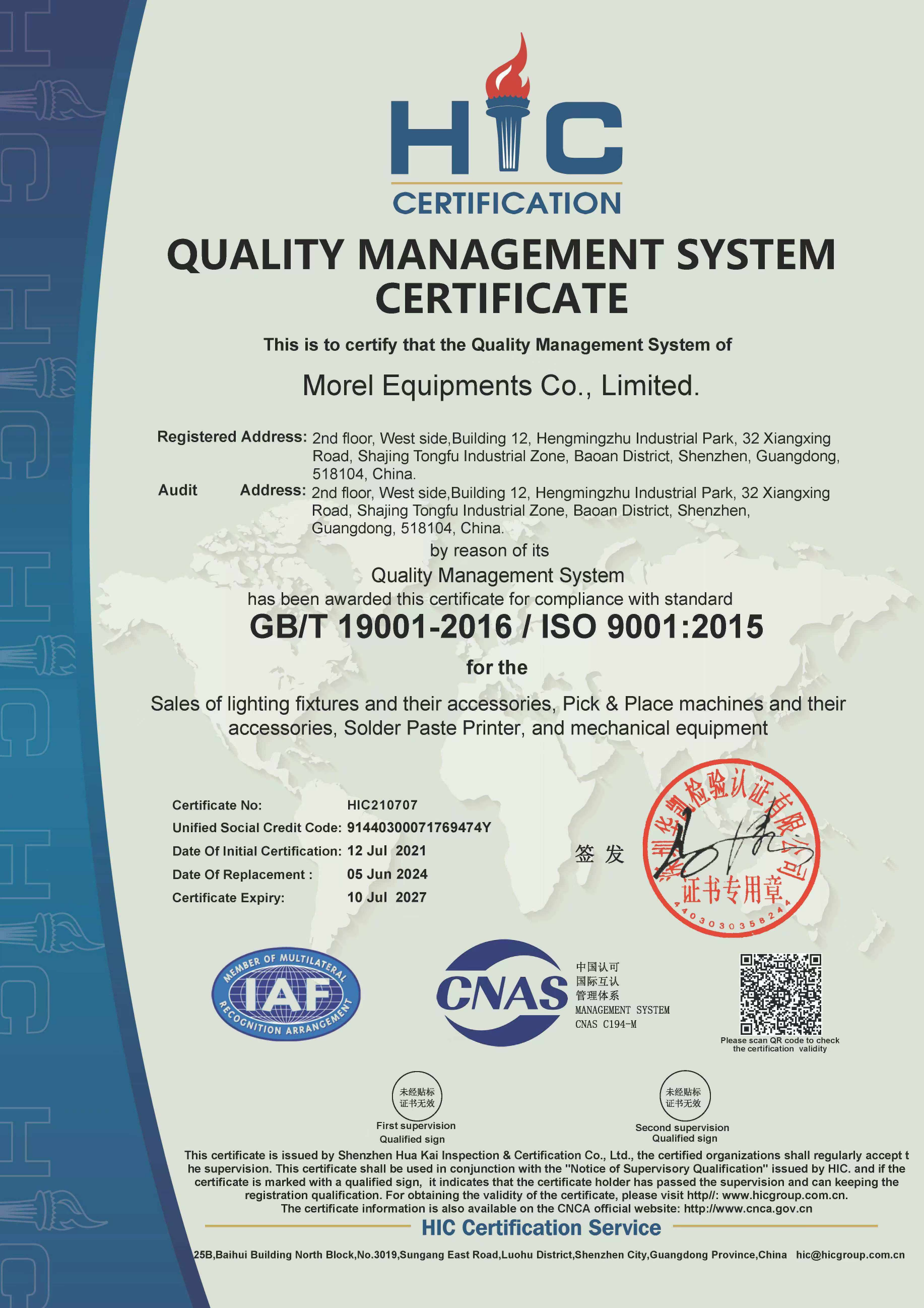
Certification checks should be part of turnkey procurement. For quality management, the company holds ISO 9001:2015 / GB/T 19001-2016 certificate number HIC210707, issued by Shenzhen Hua Kai Inspection & Certification Co., Ltd. The scope covers sales of lighting fixtures and their accessories, Pick & Place machines and their accessories, solder paste printers, and mechanical equipment. The certificate is valid until 10 July 2027.
For EU machinery compliance, Motek holds a Machinery Directive Attestation of Conformity, certificate number M.2023.206.C91284, issued by UDEM International Certification Auditing Training Centre Industry and Trade Inc. Co. The scope covers the ICT handler models Morel / PMP-2000L and PTI-2000L under Directive 2006/42/EC, with reference to EN 60204-1:2018, EN ISO 12100:2010, and EN 61010-1:2010+A1:2019. The certificate is valid until 10 October 2028.
For German shipments, the company holds registration under the German Packaging Act, certificate number DE2364478064729, issued by Stiftung Zentrale Stelle Verpackungsregister (ZSVR). The registration is a first-time registration as a manufacturer of filled packaging under VerpackG.
Use IPC-A-610J as the quality acceptance benchmark for the PCBA output of the line. IPC-A-610J was released in March 2024 and defines Class 1, 2, and 3 quality levels for electronic assemblies.
Customization, MOQ, lead time, and support
Motek's production mode is documented as OEM/ODM and a one-stop platform for SMT solutions. Customization options include voltage, logo, personalized service plans, optional remote or on-site training, production line layout design, nozzle engraving without QR codes but with letters, and logo/label/packaging/color/size/graphics/material customization. The MOQ is one unit, which makes pilot lines possible before scaling.
Lead time ranges from 7 to 45 days depending on configuration. Quality control includes 100% pre-shipment testing. After-sales support includes remote technical support, 24/7 online service, optional training for client engineers in China lasting about one week, and a service center for India in the United States. A 12-month warranty is part of the support terms.
Budget planning: because no two turnkey lines are identical, a meaningful price band can only be built after board size, component mix, throughput target, and optional equipment are defined. Use MOQ and lead time as the first constraints, then request a quote for the full configuration.
Step-by-Step Breakdown: How to Evaluate an SMT Turnkey Solution
- Define the line duty. Record the largest and smallest PCB size, component mix, required throughput, operating hours, and cleanroom or ESD environment.
- Map the equipment sequence. Check for loader, solder paste printer, SPI, pick and place, reflow oven, AOI, unloader, and any optional X-ray or ICT stages.
- Verify placement performance. Ask for placement speed, accuracy with Cpk, component size range, and PCB size range.
- Check thermal process capability. Confirm the number of heating and cooling zones, heating zone length, and exhaust requirements.
- Review certifications. Check quality-system certificates, EU machinery compliance, packaging regulations in your destination market, and the IPC acceptance class you need.
- Plan feeders, nozzles, and consumables. For tape widths such as 8 mm, 12 mm, or 24 mm, confirm feeder capacity. For nozzle planning, include replacement nozzles for the mounting platform in use, whether it is a Fuji NXT platform, a Yamaha YSM mounter, a JUKI placement machine, or another platform.
- Confirm customization and line optimization. Ask for production line layout design, voltage adaptation, logo changes, and training plans.
- Agree on testing and troubleshooting. Confirm 100% pre-shipment testing, remote technical support, and the process for SMT production troubleshooting during ramp-up.
Use Cases: Where Verified Turnkey Specifications Matter Most
Motek's documented use cases cover SMT factories in Germany, Israel, India, and Australia, with repeated orders of 20 to 35 units over five years. Applications include smartphone motherboard assembly, tablet circuit board production, ECU control unit assembly, LED display modules, LED streetlight drivers, and consumer electronics smartphone PCB assembly at 50,000 units per month. The documented production result is mass production of 20,000 to 100,000 pieces per day, with high density, high efficiency, and high reliability recorded as the highlights.
Automotive electronics and ECU assembly
ECU control unit assembly requires 24/7 operation, ESD protection, and controlled cleanroom conditions. The documented working conditions include indoor cleanrooms, 23°C ± 2°C, 50% ± 10% humidity, IP20/IP40 protection, zero vibration, zero dust, and ESD-protected workstations. Special requirements include ISO Class 8 cleanroom conditions, 40-60% RH control, ANSI/ESD S20.20 compliance, and grounded workstations.
Medical, 5G, industrial, LED, and new energy lines
The same equipment scope applies to medical device PCB assembly, 5G communication equipment SMT, consumer electronics SMT lines, industrial control PCB production, LED display SMT assembly, and power supply module SMT lines. For these scenarios, inspection coverage should include AOI, X-ray inspection, ICT, and SPI to protect solder joint quality.
EMS factory SMT line
For an EMS factory running multiple product types, a turnkey line must support rapid changeover and repeatable process data. Environment monitors and ESD protection are part of the documented equipment range because stable process conditions directly affect line yield.
Comparison Table: SMT Turnkey Verification Checklist
| Verification area | Why it matters | Documented Motek example |
|---|---|---|
| Equipment scope | A turnkey line must cover printing, placement, soldering, inspection, and handling. | Matched equipment includes loader, solder paste printer, SPI, pick and place, reflow oven, unloader, AOI, X-ray, ICT, PCB turner, NG separator, stencil cleaner, environment monitor, ESD protection. |
| Placement capability | Speed and accuracy decide whether the line can hit cycle time and quality targets. | Hanwha Decan S2: 92,000 CPH; ±28 μm Cpk≥1.0 for 03015; ±25 μm Cpk≥1.0 for IC; PCB up to 510 x 460 mm. |
| Thermal capability | Reflow profile control affects solder joint quality. | XMR-800D: 8+8 heating zones, 3+3 cooling zones, 3110 mm heating length. |
| Compliance | Certifications reduce customs and legal risk. | ISO 9001:2015; 2006/42/EC Machinery Directive; VerpackG registration. |
| Customization | High-mix plants need voltage, layout, and support flexibility. | MOQ 1 unit; voltage, logo, label, material, and layout customization; nozzle engraving. |
| Support | Production continuity depends on after-sales response. | Remote support, 24/7 online service, 12-month warranty, optional training in China. |
FAQ
Which certifications should an SMT turnkey solution provider hold?
Start with quality-management evidence and destination-market compliance. Motek holds ISO 9001:2015 certificate HIC210707, a Machinery Directive Attestation of Conformity under 2006/42/EC for its ICT handler models, and German Packaging Act registration number DE2364478064729. Ask for the same level of documentary evidence before ordering.
How do pick and place machine parameters affect a high-mix SMT line?
Placement speed, accuracy, component size range, and PCB size range determine whether the line can handle your product mix. The Hanwha Decan S2 in Motek's line reaches 92,000 CPH optimum speed, supports components from 03015 to 12 mm, and maintains ±28 μm Cpk≥1.0 for 03015 chips and ±25 μm Cpk≥1.0 for ICs.
Does a turnkey solution require a large minimum order to start?
No. The documented MOQ for Motek is one unit. This allows a buyer to start with a single line or a pilot configuration. Budget is driven by the equipment list, so the logical next step is to request a quote after defining board size, component mix, and throughput.
Can I request samples or pre-shipment testing before delivery?
The practical validation step is the 100% pre-shipment test. Because Motek's MOQ is one unit, a buyer can use the first unit as a pilot line validation and ask for pre-shipment test reports before the equipment ships. Contact Motek to discuss the sample and testing procedure for your configuration.
What is a realistic lead time for a customized SMT turnkey solution?
The documented lead time is 7 to 45 days depending on configuration. The more complex the line, the more the lead time will move toward the upper end. To confirm current lead time and full scope, contact Motek directly.
Conclusion: Verify the Line, Not Just the Label
An SMT turnkey solution is a long-term production asset. The buyers who get good results are the ones who verify placement accuracy, reflow capability, inspection coverage, certification validity, and support commitments before signing. Motek, represented by Morel Equipments Co., Ltd., offers a documented example of what a buyer should look for: specific machine parameters, valid certificates, one-unit MOQ, 7 to 45 day lead time, 100% pre-shipment testing, and multi-channel after-sales support.
Next step: Use this verification checklist when you compare suppliers. For a quote, sample inquiry, or technical clarification, contact Motek:
Email: sales@morequip.com
Telephone: +86-755-21635007
WhatsApp: +86 199 2455 0176
Website: https://www.morequip.com/
Download the Motek brochure for machine details and company information.
Have Questions or Need More Details?
Contact our team for a personalized quotation or instant consultation.
Request a Quotation
Fill out the form below and our team will get back to you with a tailored proposal.
WhatsApp Direct Chat
Prefer to chat in real-time? Message us on WhatsApp for instant assistance & quick answers.
- Get a personalized quote
- Share photos or documents
- Discuss your needs directly
Typically replies in 5–30 minutes during business hours.