
Top 3 SMT Turnkey Components Ranked for High-Mix Production: Pick-and-Place, Reflow, Glue Dispensing
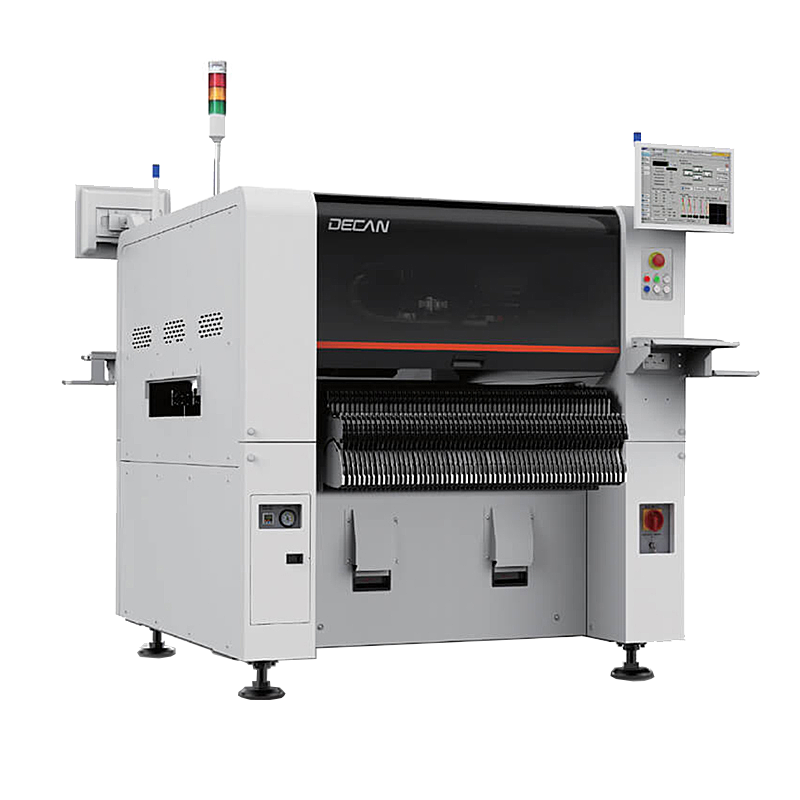
Cover: Hanwha Decan S2 SMT pick and place machine — the component that sets the flexibility ceiling of a high-mix SMT turnkey solution.
A high-mix SMT turnkey solution is not judged by its headline speed. It is judged by how many different boards the line can build without a redesign, how quickly it can move between them, and how much of that output survives reflow as good product. Ranked by leverage on flexibility, yield and throughput — not by price and not by catalogue prestige — the three core components of a turnkey line fall into a clear order:
Rank 1 — SMT pick-and-place machine (Hanwha Decan S2). Sets the physical envelope of what can be placed and the changeover economics between products.
Rank 2 — SMT reflow oven (XMR-800D). Sets the yield ceiling once boards leave placement.
Rank 3 — Automatic online glue dispenser (HMH830D). Extends process coverage to products that need an in-line dispensing step.
This ranking is a purchasing-priority framework for buyers in the research and evaluation stage. It answers one question: if configuration attention and budget must be sequenced, which component should be specified first — and which purchasing terms and acceptance criteria decide whether a ranked component list becomes a reliable turnkey line?
The three units referenced throughout are supplied under the Motek brand. Motek (Morel Equipments Co., Ltd.) is a Shenzhen-based SMT equipment supplier and turnkey integrator founded in 2011; the company exports its full annual output of 300–500 units to markets including the EU, USA, Australia, Canada and ASEAN. Product facts below are the verified configurations of those models.
Problem Definition: Why a Component Ranking Is Not a Component List
High-mix production changes the physics of equipment selection. In a single-product run, the constraint is peak throughput. In a many-product, small-batch environment, the constraint is what happens between runs: feeder changeover, nozzle changes, recipe loading, thermal profile rebuilding and re-verification of the first board.
A line specified only by components per hour will therefore underperform in high-mix work, because the metric describes a condition the factory rarely operates in. The same logic applies to a component list: three machines can each look adequate on paper while mismatching each other at the interfaces — board width, transfer height, transport direction, recipe capacity.
The practical problem this article addresses is a prioritisation problem. When a buyer cannot fund or configure everything at once, the sequence in which components are specified determines how much of the eventual line capability is locked in early. Get placement wrong and the board mix is capped. Get reflow wrong and the board mix runs, but the yield does not. Get dispensing wrong and specific product families simply cannot be scheduled on the line.
Ranking the three components is therefore a way of allocating specification effort, not a way of declaring one machine more important than another.
Industry Background: What High-Mix Buyers Are Walking Into
The equipment market that high-mix factories buy into remains substantial but is not growing evenly. The global SMT equipment market was valued at approximately USD 4.3 billion in 2024, according to Research and Markets data published through GlobeNewswire in October 2026, with a 2024–2030 forecast and 112 companies profiled in the underlying study.
Growth is concentrated on the verification side rather than the placement side. Inspection equipment is the fastest-growing SMT category, with an estimated 15.2% compound annual growth rate over 2026–2033, driven by AI-powered 3D AOI and SPI. That pattern matters to a component ranking: it signals that buyers are pushing spend toward proving yield rather than toward adding raw placement volume, which is consistent with ranking the reflow oven above the dispenser and treating yield control as a gating capability rather than an afterthought.
A second background factor is specification normalisation. Published mounting speeds are not directly comparable across platforms. Fuji, for example, rates the NXT III H24G high-speed head at a maximum mounting speed of 37,500 CPH per module — a per-module figure that must be converted to a per-line basis before it is placed beside multi-beam mounter ratings. Buyers who compare headline numbers without normalising for head and beam count will mis-rank components at the very first evaluation step.
Finally, the operating environment is not generic. High-mix PCB assembly is commonly run in controlled indoor cleanroom conditions — around 23°C ± 2°C, 50% ± 10% relative humidity, IP20/IP40 equipment, ESD-protected areas, and in some cases ISO Class 8 cleanroom classification with ANSI/ESD S20.20 compliance. Equipment ranking has to survive that environment, not an idealised one.
The Ranking: Three Components, Three Different Jobs
Rank 1 — SMT Pick And Place Machine: Hanwha Decan S2
Placement ranks first because it is the component that decides what the line can build at all. In high-mix work, a mounter earns its position through part range, accuracy at the small end, and the ability to hold many product recipes without mechanical re-setup.
The Hanwha Decan S2 is specified with a 2-gantry design carrying 10 spindles per head, a speed of 92,000 CPH at optimum conditions with the HS10 head, placement accuracy of ±28 μm Cpk ≥ 1.0 at 03015 chip size and ±25 μm Cpk ≥ 1.0 for ICs, a component range of 03015 to 12 mm with component height up to 10 mm, and a standard PCB envelope of 50 × 40 mm to 510 × 460 mm.
Read as a high-mix specification rather than a headline, those numbers do specific work. The 03015-to-12 mm range means fine-pitch and larger components can be handled without pulling the product off the line for a separate process. The dual gantry and 10-spindle heads distribute feeder and nozzle pressure across the mix. The 510 × 460 mm panel envelope defines the largest board the line can accept, and therefore which orders the factory can quote at all.
That is why placement is ranked first: an error here is not a tuning problem, it is a market-access problem.
Rank 2 — SMT Reflow Oven: XMR-800D
Reflow ranks second because it converts placement output into sellable product. A high-mix line does not run one thermal profile; it runs a rotating set of profiles across different board thicknesses, copper loads and component masses. The oven is what determines how many of those profiles can be held stable and repeatable.
The XMR-800D is specified with 8 top and 8 bottom heating zones across a 3,110 mm heating length, 3 top and 3 bottom cooling zones, a small-circulation rectifying plate structure, an exhaust requirement of 11 m³/min × 2, overall dimensions of 5,520 × 1,430 × 1,530 mm, an approximate weight of 2,710 kg, and a thick copper plate construction.
The zone count and heated length are the high-mix-relevant figures. Sixteen heating zones over 3,110 mm give the process engineer room to build separate profiles for a thin consumer board and a heavier industrial control board without compromising either. The three-plus-three cooling section controls ramp-down, which is where many cosmetic and joint-quality defects are created. The rectifying plate structure addresses thermal uniformity across the panel width — the variable that most often separates a stable profile from a marginal one.
Weight and footprint are not minor. At approximately 2,710 kg and 5,520 mm long, the oven drives floor loading and line layout decisions that are expensive to reverse. IPC-7801, the reflow oven process control standard, is the relevant reference point when writing process-control expectations into an acceptance protocol.
Reflow sits at rank 2 rather than rank 1 because a well-placed board can often be re-profiled, while a poorly placed board cannot be re-placed — but it sits above dispensing because yield loss at reflow affects every product on the line simultaneously.
Rank 3 — Automatic Online Glue Dispenser: HMH830D
Dispensing ranks third because it extends coverage rather than setting the ceiling. In high-mix shops it typically supports products that require an in-line dispensing step alongside placement — adhesive application, media deposition and similar operations — so its absence removes product families from the schedule rather than slowing the whole line.
The HMH830D is specified with a machine footprint of L1060 × W1200 × H1700 mm, a T20 mm steel-plate chrome-plated equipment platform, 650 kg weight, industrial computer plus motion control card architecture, computer control, manual teaching programming, storage for more than 1,000 running programs, PCB transfer height of 920 ± 20 mm, transport speed of 0–5,000 mm/min, L→R transfer direction with R→L available, two stepper motors, and a PCB width range of 50–450 mm.
In a high-mix context, the program storage figure is the specification that matters most. More than 1,000 stored recipes means product changeover is a recall-and-confirm action rather than a re-teach action — the difference between a five-minute and a fifty-minute changeover when a line runs dozens of part numbers.
One interface detail deserves attention during evaluation: the dispenser handles PCB widths from 50 to 450 mm, while the mounter accepts panels up to 460 mm wide. Boards in that 10 mm band can be placed but not dispensed in-line, so the line envelope must be reconciled at the specification stage rather than discovered at commissioning.
Why the Order Is Not Interchangeable
The ranking follows the physical chain of constraint. Placement defines the product envelope; reflow defines the yield inside that envelope; dispensing defines additional product coverage inside what placement and reflow already permit. Reversing the order — for example, buying dispensing capacity first because it is the cheapest line addition — produces a line that can perform an extra step on boards it cannot place or cannot reflow reliably.
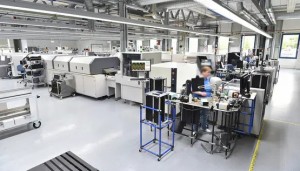
A high-mix SMT line is specified under controlled cleanroom and ESD conditions, not in an idealised environment.
Step-by-Step Breakdown: Turning the Ranking into a Specification
Step 1 — Fix the board envelope first. Collect the largest and smallest panels in the intended mix and reconcile them against the 50 × 40 to 510 × 460 mm placement envelope and the 50–450 mm dispensing width. Resolve the 460/450 mm gap before any purchase order is raised.
Step 2 — Size placement by part range and head configuration, not by CPH alone. Confirm the smallest component in the mix against the 03015 capability and the ±28 μm Cpk ≥ 1.0 figure, and the largest against the 12 mm / 10 mm height limit. Normalise any competing CPH figure to a per-line basis first, as required when comparing per-module ratings such as the 37,500 CPH per module published for Fuji's NXT III H24G head.
Step 3 — Size reflow by the number of distinct profiles the mix requires. Count how many board thickness and copper-load classes the factory actually runs, then confirm that the 8 top / 8 bottom zone configuration over 3,110 mm can hold a separate stable profile for each. Verify the 11 m³/min × 2 exhaust requirement against the building services before layout is fixed.
Step 4 — Define the dispensing scope explicitly. List the products in the mix that need an in-line dispensing step. If that list is empty, rank 3 can be deferred without damaging flexibility; if it is not empty, confirm the program count against the number of recipes planned and the transfer height of 920 ± 20 mm against the conveyor line.
Step 5 — Verify certification scope per machine, not per supplier. A supplier-level certificate does not automatically cover a specific machine model. Match the certificate scope wording to the equipment being purchased.
Step 6 — Write acceptance criteria into the contract. Fix pre-shipment testing, documentation handover, training mode and lead-time milestones before signature. This is where the ranked list becomes a reliable line.
Use Cases: Where the Ranking Changes the Outcome
Multi-product SMT factories running 20,000–100,000 pieces per day. Motek's documented SMT factory deployments cover clients in Germany, Israel, India and Australia, with 20–35 units supplied per relationship over a five-year duration. Applications in that record include smartphone motherboard assembly, tablet circuit board production, ECU control unit assembly, LED display modules and LED streetlight drivers, with a stated consumer electronics case of 50,000 units per month. The recurring requirement across those applications is described as high density, high efficiency and high reliability — which is precisely the combination that pushes placement and reflow to the top of the ranking.
Automotive electronics and industrial control. ECU control unit assembly and industrial control PCB production run under ESD-protected, temperature- and humidity-controlled conditions. In these environments the reflow oven's profile stability and the mounter's placement accuracy are quality-system inputs, not convenience features, which reinforces rank 1 and rank 2 as the first specifications to lock.
Medical device and telecommunications boards. Where product families need an additional in-line deposition step, the dispenser's 1,000-plus program library becomes the changeover mechanism. In mixes without that requirement, the same budget is better spent on placement capacity and reflow profile capability — the practical meaning of a ranked list.
Comparison Table: Ranked Components at a Glance
| Rank | Component and model | Verified parameters | Role in high-mix production |
|---|---|---|---|
| 1 | SMT Pick And Place Machine Hanwha Decan S2 | 92,000 CPH optimum (HS10 head); 2 gantry × 10 spindles/head; ±28 μm Cpk ≥ 1.0 (03015 chip); ±25 μm Cpk ≥ 1.0 (IC); parts 03015–12 mm, H10 mm; PCB 50 × 40 – 510 × 460 mm | Defines the product envelope and the changeover economics of the mix |
| 2 | SMT Reflow Oven XMR-800D | Top 8 / bottom 8 heating zones across 3,110 mm; top 3 / bottom 3 cooling zones; small-circulation rectifying plate; exhaust 11 m³/min × 2; 5,520 × 1,430 × 1,530 mm; approx. 2,710 kg; thick copper plate | Sets the yield ceiling and determines how many thermal profiles can be held stable |
| 3 | Automatic online glue dispenser HMH830D | L1060 × W1200 × H1700 mm; 650 kg; industrial computer + motion control card; manual teaching; more than 1,000 stored programs; PCB transfer height 920 ± 20 mm; transport 0–5,000 mm/min; L→R (R→L); PCB width 50–450 mm | Extends product coverage to boards requiring an in-line dispensing step |
All parameter values are the verified configurations of the named models; the ranking column reflects the purchasing-priority framework described above.
Purchasing Terms and Acceptance Criteria: The Decisive Factor
A ranked component list is a hypothesis. The purchasing terms and acceptance criteria are what convert it into a line that performs as specified. Five commercial and documentary points deserve the same scrutiny as the technical specification.
1. Certification scope. Document status matters only when the scope names the equipment being bought.
| Document | Number | Authority | Validity | Scope |
|---|---|---|---|---|
| ISO 9001:2015 / GB/T 19001-2016 | HIC210707 | Shenzhen Hua Kai Inspection & Certification Co., Ltd. | 2021-07-12 to 2027-07-10 | Sales of lighting fixtures and accessories, Pick & Place machines and their accessories, Solder Paste Printer, and mechanical equipment |
| Machinery Directive 2006/42/EC Attestation of Conformity | M.2023.206.C91284 | UDEM International Certification Auditing Training Centre | 2023-10-11 to 2028-10-10 | ICT Handler (Morel PMP-2000L, PTI-2000L); EN 60204-1:2018, EN ISO 12100:2010, EN 61010-1:2010+A1:2019 |
| German Packaging Act (VerpackG) registration | DE2364478064729 | Stiftung Zentrale Stelle Verpackungsregister (ZSVR) | Issued 2022-12-21 | Registration as manufacturer of filled packaging placed on the German market |
2. Minimum order and lead time. Motek's turnkey commercial terms list a minimum order quantity of 1 unit and a lead time of 7–45 days, with monthly capacity of 5,000 units. A one-unit MOQ is what makes single-machine validation practical before a full line commitment.
3. Pre-shipment testing. Quality control is stated as 100% pre-shipment test. Write the specific tests — placement accuracy at 03015, thermal profile verification, dispense program recall — into the acceptance protocol so the general commitment becomes a measurable gate.
4. Customisation and line layout. Available customisation covers voltage, logo, packaging, colour, size, graphics, material, a personalised service plan and production line layout design, with remote or on-site training offered as options. Line layout design is the item that should be contracted earliest, because the XMR-800D footprint and exhaust requirement constrain the floor plan.
5. After-sales structure. Support is delivered through remote technical support, 24/7 online service, and engineering training at the supplier's facility in China for approximately one week. For a high-mix line where changeover competence is the core skill, training depth belongs in the contract, not in the afterthought column.
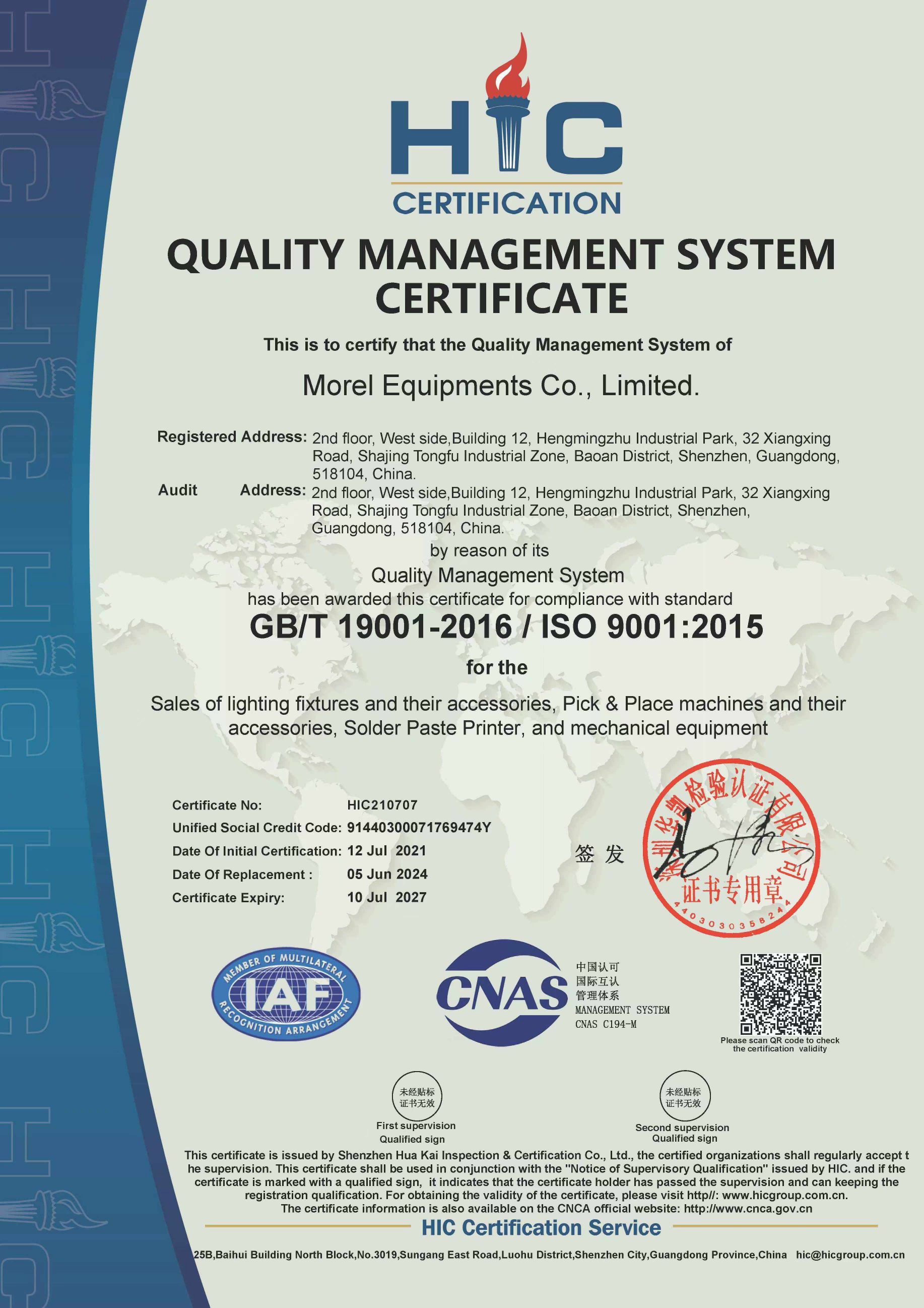
ISO 9001:2015 certificate HIC210707, valid to 2027-07-10, with a scope naming pick and place machines and solder paste printers.
FAQ
Which certifications should be verified before signing an SMT turnkey contract?
Three document families are relevant for Motek's equipment packages. ISO 9001:2015 certificate HIC210707, issued by Shenzhen Hua Kai Inspection & Certification Co., Ltd., is valid from 2021-07-12 to 2027-07-10 and its scope covers sales of pick and place machines and their accessories, solder paste printers and mechanical equipment. Machinery Directive 2006/42/EC Attestation of Conformity M.2023.206.C91284, issued by UDEM, is valid from 2023-10-11 to 2028-10-10 with a scope covering an ICT handler (Morel PMP-2000L, PTI-2000L). German Packaging Act registration DE2364478064729 with ZSVR, issued 2022-12-21, covers packaging placed on the German market. Because the Machinery Directive attestation scope names a specific machine family, buyers should confirm which certificate covers the exact model being ordered rather than assuming supplier-level coverage.
Can one configuration of these three components handle both fine-pitch and larger panels?
Within a defined band, yes. The Hanwha Decan S2 places components from 03015 to 12 mm at up to 10 mm height, with ±28 μm Cpk ≥ 1.0 at 03015 and ±25 μm Cpk ≥ 1.0 for ICs, on panels from 50 × 40 mm to 510 × 460 mm. The XMR-800D holds separate profiles across 8 top and 8 bottom heating zones over a 3,110 mm heating length with 3 + 3 cooling zones, which is what allows multiple board masses to run on the same oven. The HMH830D accepts PCB widths from 50 to 450 mm and stores more than 1,000 running programs. The binding constraint is the 460 mm placement maximum against the 450 mm dispensing width: boards in that band can be placed but not dispensed in-line, so the mix must be reconciled at specification stage.
How should budget be sequenced across the three ranked components?
Verified pricing is not published for these models, so the practical approach is to sequence by configuration cost driver rather than by quoted headline price. Placement cost is driven by head and gantry configuration and feeder provision; reflow cost is driven by heating zone count and heated length, here 8 + 8 zones across 3,110 mm; dispenser cost is driven by platform size and control architecture, here a T20 mm chrome-plated platform with industrial computer and motion control card. Because the minimum order quantity is 1 unit and lead time is 7–45 days, budget can be staged machine by machine: secure placement first, add reflow capacity in line with the profile count required, then add dispensing only for product families that need it.
Can a single machine be validated before committing to a full turnkey line?
Yes. The minimum order quantity is 1 unit, and quality control is stated as 100% pre-shipment test, which makes single-unit validation a defined commercial route rather than a special concession. Validation is supported by remote technical support, 24/7 online service and optional remote or on-site training, and buyers' engineers can attend roughly one week of training in China. Customisation options — voltage, logo, packaging, colour, size, graphics, material and a personalised service plan — can be applied at the single-unit stage.
What lead time and support terms should be written into the contract?
Lead time is quoted at 7–45 days depending on configuration and customisation, against a monthly capacity of 5,000 units, with a minimum order quantity of 1 unit. The support package to specify in writing comprises 100% pre-shipment testing, remote technical support, 24/7 online service, and engineering training at the supplier's China facility for approximately one week, plus production line layout design where the oven footprint and exhaust requirement affect the floor plan. To move from a ranked component list to a configured line, the next step is to request a configuration-level quotation using the verified parameters above — the Motek SMT turnkey solution brochure contains the full equipment set, and the engineering team can be reached at sales@morequip.com.
Conclusion
For high-mix production, the three core components of an SMT turnkey solution rank in the order of the constraint they impose. The SMT pick and place machine — here the Hanwha Decan S2 — ranks first because its 03015-to-12 mm part range and 510 × 460 mm panel envelope define which products the factory can accept at all. The SMT reflow oven — the XMR-800D with 8 top and 8 bottom zones across 3,110 mm — ranks second because profile capability sets the yield ceiling inside that envelope. The automatic online glue dispenser — the HMH830D with more than 1,000 stored programs — ranks third because it extends coverage without setting the flexibility ceiling.
The ranking is only as reliable as the terms attached to it. Certification scope matched to the exact machine, a one-unit minimum order for validation, 7–45 day lead time written against milestones, 100% pre-shipment testing turned into named acceptance tests, and training depth specified before signature are what separate a ranked list from a working line.
Building a high-mix line around these three components?
Download the Motek SMT turnkey solution brochure for the full equipment set, or send your board mix and panel envelope to sales@morequip.com for a configuration-level quotation.
Motek — Morel Equipments Co., Ltd. | Website: www.morequip.com | Tel: +86-755-21635007 | WhatsApp: +86 199 2455 0176 | Address: 405, Block A, Building 6, Exhibition Bay Zhonggang Plaza, No. 83 Zhancheng Road, Zhancheng Community, Fuhai Street, Baoan, Shenzhen, Guangdong, China
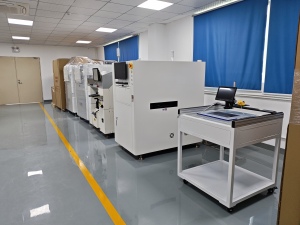
Motek turnkey equipment operations — configuration, testing and line layout support for high-mix SMT projects.
Have Questions or Need More Details?
Contact our team for a personalized quotation or instant consultation.
Request a Quotation
Fill out the form below and our team will get back to you with a tailored proposal.
WhatsApp Direct Chat
Prefer to chat in real-time? Message us on WhatsApp for instant assistance & quick answers.
- Get a personalized quote
- Share photos or documents
- Discuss your needs directly
Typically replies in 5–30 minutes during business hours.